Smart building systems are the technologies and workflows that secure, connect, monitor and operate a property. A truly smart building goes beyond connected devices in each apartment: it coordinates the base building, the units, the people and the daily workflows, anticipates what is coming, and runs the way its owners and operators want it to.
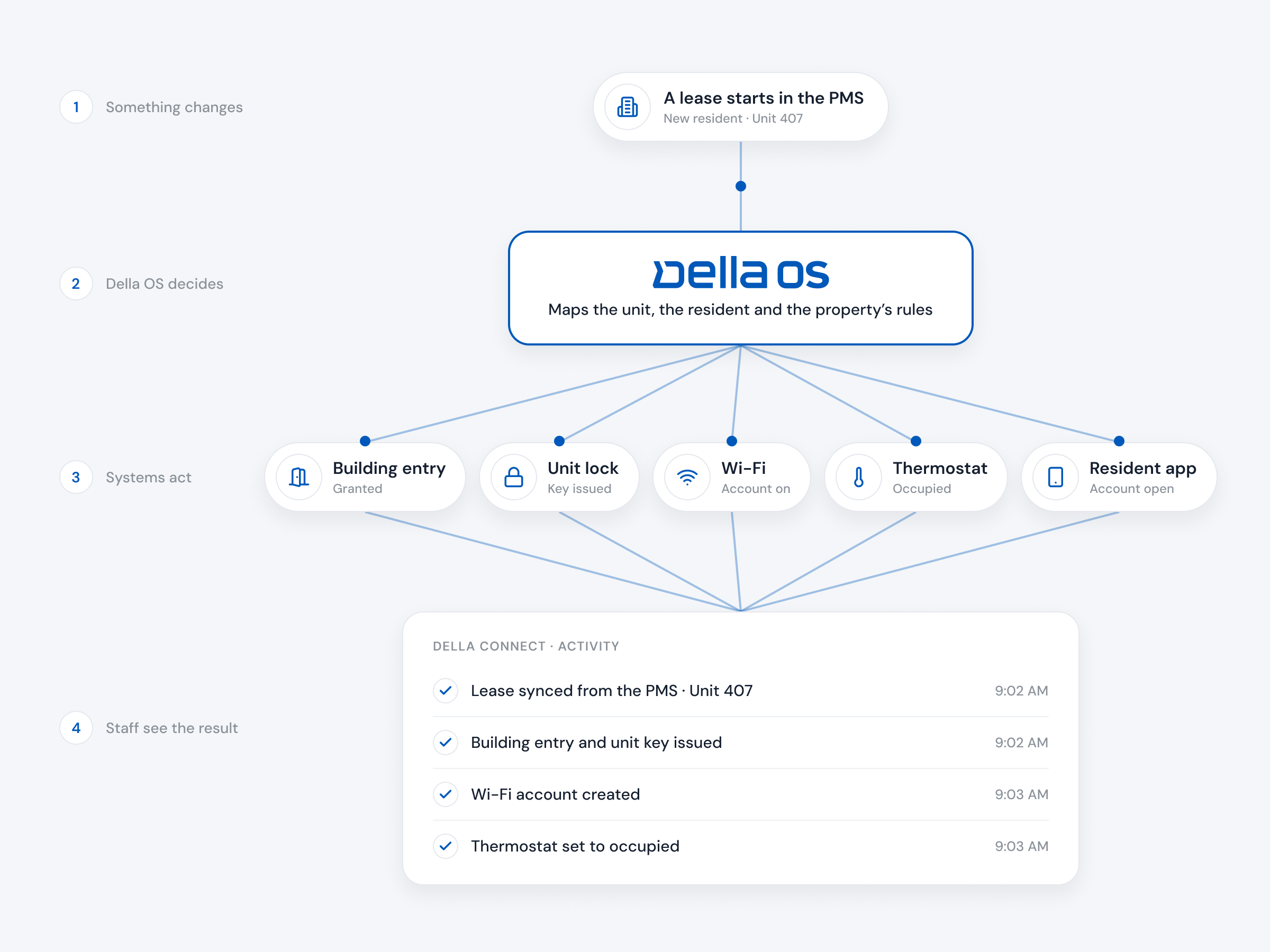
The word smart gets used lightly. Much of what is sold as a smart building is really a smart apartment: a lock, a thermostat and an app inside each unit. A smart building covers the entire building envelope. It includes smart base building systems, such as access control, EV chargers and common area equipment, and smart units with their own locks, thermostats and sensors. Just as important, much of the work of running a building has nothing to do with hardware at all. It is a series of events: a lease is signed, a resident moves in, a vendor needs access, a unit goes vacant, a lease ends. Every one of those events creates tasks across systems and people, and without coordination they add up to the operational drag that wears down site teams.
A smart building connects three layers. The base building layer covers shared systems such as entrances, access control, EV chargers and common areas. The unit layer covers what is inside each home: locks, thermostats, leak sensors and Wi-Fi. The operations layer ties both to people and workflows: residents, staff, vendors, and the leases and events that decide what should happen next. The smartest buildings also look ahead. They know a lease is ending before the move-out, have a unit ready before a new resident arrives, and flag a device that needs attention before it fails. And they adapt to how the team and the ownership want to operate. Student housing, senior living, conventional multifamily and commercial buildings each run differently, with their own rules for access, visitors, communication and turnover. A building is only as smart as the operating system that runs it, and a smart enough operating system can be shaped to handle each of them.
Della OS is the operating system that makes the whole building smart, not just the units. It connects supported base building systems, unit technology and the property management system, and turns each event, such as a signed lease, a move-in, a vacancy or a move-out, into the steps that should follow across systems and people. Owners and operators decide how their buildings run, and Della OS carries out those rules consistently, whether the property is student housing, senior living, conventional multifamily or commercial. Property teams use Della Connect, residents use Della Resident, and integration partners set up each property with Della's partner tools. Because Della normalizes how each category works, buildings with completely different equipment still run the same way.
Less operational drag, fewer manual steps between systems and people, buildings that run the way you want them to, and an operating standard that scales across every property type in the portfolio.
A smart apartment has connected devices inside the unit, usually a lock, a thermostat and an app. A smart building connects those units with the base building systems, the property management system and the people who run the property, so events like a move-in or a vacancy are handled across the whole building instead of one device at a time.
Not necessarily. Many properties keep the locks, access control, intercoms and thermostats they already trust. Before deployment, a Della integration partner inventories each system by brand and model, confirms what connects to Della OS, and recommends replacing equipment only where it can't be supported or is due for replacement anyway.
No. More than half of Della OS runs without any building equipment, including PMS sync, the resident app, messaging, amenity booking, packages and maintenance. Equipment such as access control, locks and thermostats can be added later, one building or one category at a time, as the business case supports it.
Yes. Portfolios rarely have the same equipment everywhere. Della OS keeps the same workflows, roles and resident experience across properties even when the locks, intercoms or thermostats differ, so teams don't have to learn a new process at each building.
Smart building systems that work with Della OS · Building operating system · Occupancy Sync · Della Connect · Della Resident


